The Context Problem: Why Deals Die After Qualification
Qualified leads stall not because prospects aren't ready, but because the context that explains their intent never survives the handoff to Sales.
Osnat Lidor · June 5, 2026 · 6 min read
Most B2B revenue leaders know the feeling. A lead comes in looking strong. ICP match. Solid engagement signals. Marketing hands it off and considers the job done. Then the deal stalls, goes quiet, and eventually gets marked closed-lost with a vague reason no one can fully explain.
The instinct is to blame the lead. It wasn't ready. The timing was off. The prospect was just doing research.
Sometimes that's true. But often, the deal didn't die because of the prospect. It died because of what got lost in the handoff.
Qualification Is Not the Finish Line
There's a persistent misconception in B2B go-to-market that qualification is the moment of truth. Get the lead to MQL, pass it to Sales, and let the funnel do its job. What this framing misses is that qualification is a gate, not a guarantee. What happens after the gate depends entirely on what Sales knows when they walk in.
And right now, most Sales teams walk in knowing very little.
They get a name, a title, a lead score, and maybe a campaign source. What they don't get is the behavioral and situational context that actually explains why this person raised their hand. What content did they spend time with? What pain point surfaced in the form response? What triggered their search at this moment versus six months ago?
That context lives in Marketing's world. It rarely survives the handoff intact.
What Gets Lost and Why It Matters
The gap isn't usually a technology problem. Most companies have a CRM. Most have marketing automation. The data exists somewhere. The problem is that the data being passed is transactional, not interpretive.
A contact record tells Sales what happened. It doesn't tell them what it means. And meaning is what drives a relevant first conversation.
When Sales doesn't know a prospect came through a competitor comparison page, they pitch the wrong value proposition. When they don't know the prospect spent time on the pricing page, they miss the urgency signal. When they don't know what problem the prospect articulated in their own words, they start the discovery call asking questions the prospect already answered weeks ago.
The prospect notices. It doesn't feel like a warm handoff. It feels like starting over with someone who didn't do their homework. That's a trust problem before the relationship has even begun.
The Real Culprit: Misaligned Expectations
Timing and data quality get blamed most often. Both are real issues. But the deeper problem, the one that makes timing and data failures so persistent, is that Marketing and Sales don't share a definition of what a good handoff actually looks like.
Marketing defines a qualified lead as someone who fits the ICP and demonstrated intent. Sales defines it as someone ready to have a buying conversation in the next 30 days. Both definitions are reasonable. Neither team wrote theirs down. Neither team agreed to the other's.
So the same argument replays every quarter. Marketing points to volume. Sales points to close rates. Leadership calls it a "pipeline quality" problem and moves on. Nothing changes because the root cause, a definitional mismatch that's been treated as a cultural quirk rather than an operational failure, never gets addressed.
Leads sit in limbo not because routing broke but because Sales doesn't trust what's coming through. So they wait, deprioritize the inbound, and focus on their own outbound. The Marketing-sourced lead goes cold while someone debates whether it was ever really qualified.
What a Fix Actually Requires
The companies that get this right treat the handoff as a contract, not a courtesy.
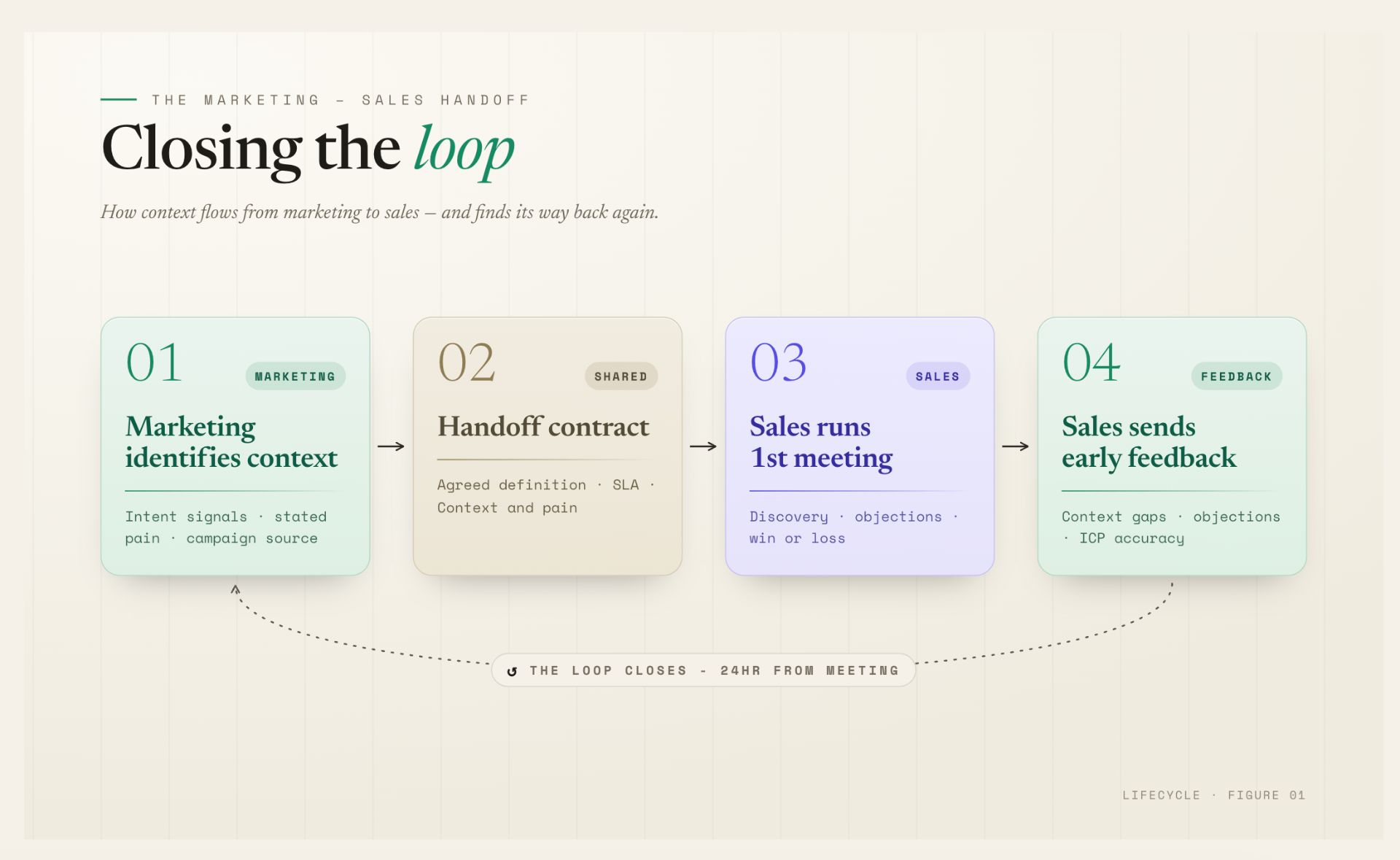
That means agreeing on what a handoff-ready lead looks like, in writing, with input from both teams. It means defining what Sales commits to doing with a lead, and when, so Marketing can hold them accountable. It means building a feedback loop where Sales tells Marketing what context was useful, what was missing, and what they're hearing in early conversations that could inform upstream messaging.
It also means rethinking what gets captured and surfaced in the CRM. Not just activity data. Intent signals. The words a prospect used to describe their problem. The content that moved them. The moment that made them act.
None of this is technically complicated. All of it requires organizational will that most teams don't prioritize until the pipeline has already suffered.
The Cost of Getting It Wrong
A stalled deal after qualification isn't just a lost opportunity. It's a signal that the revenue system has a structural gap. Marketing spent budget to generate the lead. Sales spent time on a call that went nowhere. Both teams walk away with a story that confirms their existing frustration with each other.
The answer isn't better technology, or a longer lead nurture sequence, or tighter scoring thresholds. The answer is treating context as a first-class deliverable, something that gets designed, handed off deliberately, and measured like any other revenue input.
The deals that die after qualification usually weren't unwinnable. They were just underprepared for.
Written by Osnat Lidor
Talk to us