Why Most Case Studies Are Worthless (And the 7 Questions That Fix That)
Osnat Lidor · May 30, 2026 · 8 min read
You have AI that writes in seconds. You have Gong with every customer call recorded and transcribed. You have more content tools, more automation, and more access to customer data than any marketing team in history.
And companies are still publishing case studies that say absolutely nothing.
A customer talking about their own business. A quote about loving the CSM. Some numbers dropped in without any context. A logo slapped on top and called done.
That is not proof. That is noise.
The Problem Is Not the Writing
Most teams assume the case study problem is a content problem. They bring in a better writer, use a fancier template, run it through AI to polish the language. The output looks cleaner. It still does not work.
Because the problem was never the writing.
It was always the interview.
Case studies fail at the source, not the page. When you interview a customer without business outcomes in mind, you get a customer talking about their own experience in their own language with no structure a reader can follow. They are happy to talk. They just are not being guided toward anything useful.
The result is a story without a spine. A reader cannot place themselves in it. A sales team cannot use it. An SEO team gets thin content with no search intent behind it.
The fix is not a better template. It is better questions.
The Only Structure That Works
Every case study that actually drives results follows the same shape:
Challenge. Solution. Outcome.
That is it. Three phases. The reader needs to feel the pain before they believe the solution mattered. They need to see the solution before the numbers mean anything. And they need the numbers to land with full context, not floating in a vacuum.
Most case studies skip the challenge entirely and lead with the outcome. "Company X increased revenue by 40%." Great. For what problem? Starting from where? Against what alternative? Without that context, 40% is just a number. It does not move anyone.
Build the story in order and every piece earns its place.
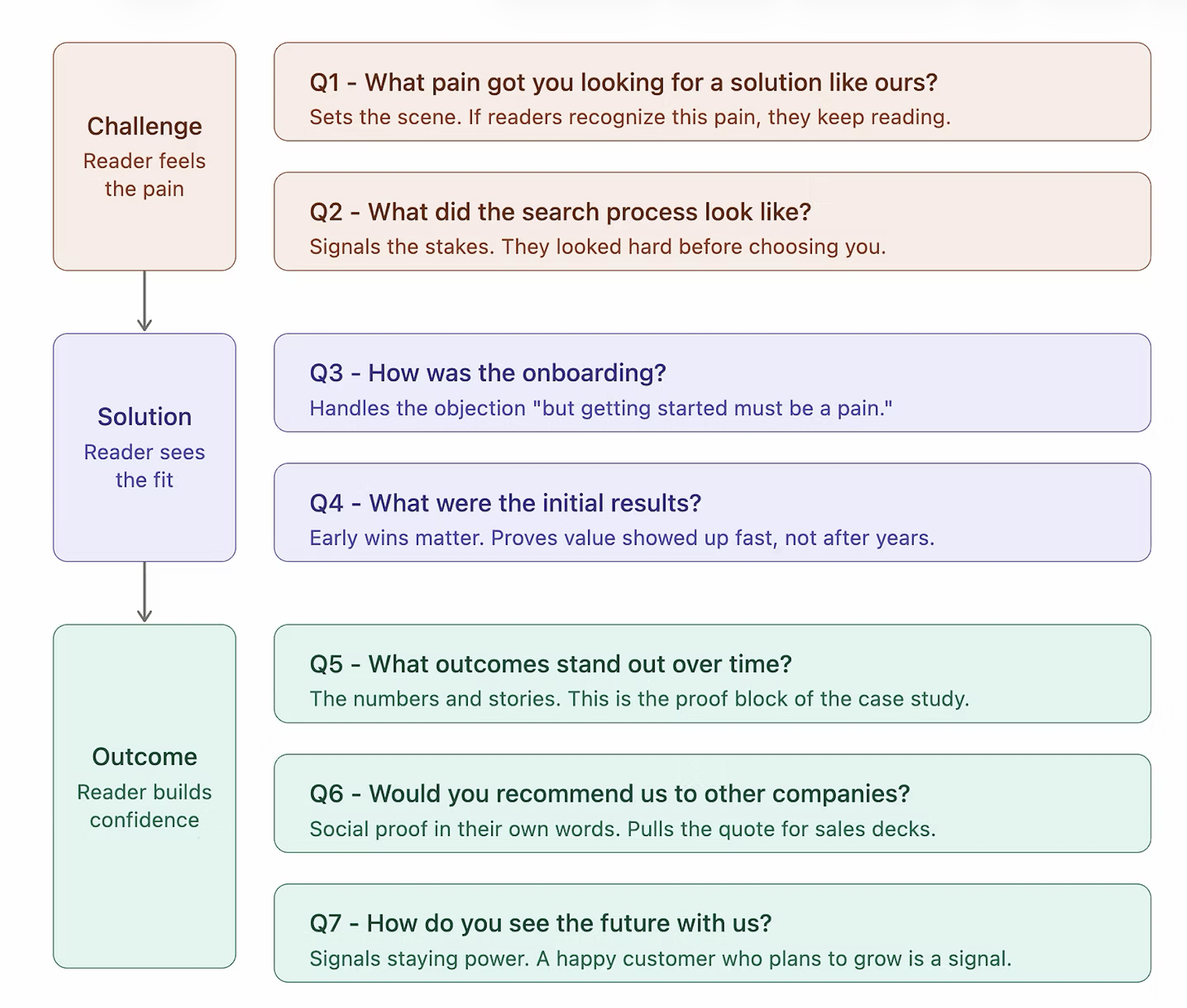
The 7 Questions That Build the Story
These questions are not complicated. They are intentional. Each one does a specific job in the narrative.
1. What was the pain that got you looking for a solution like ours?
This is the most important question in the interview. It opens the challenge phase and it gives future readers a mirror. If they recognize the pain, they keep reading. If they do not, they leave. A specific, honest answer here is worth more than everything else in the case study combined.
2. What did the search process look like?
Most interviewers skip this one. That is a mistake. This question does something the others cannot: it tells the reader the customer had options, evaluated them, and chose you anyway. That is not a small thing. It turns the case study from "a customer used our product" into "a customer made a deliberate decision after comparing alternatives." The credibility gap between those two is significant.
3. How was the onboarding?
Every buyer considering your product has a version of this objection somewhere in their mind: "But getting started must be painful." This question gives your customer the chance to answer it for you. A strong answer here removes friction before the sales conversation even happens.
4. What were the initial results?
Early wins matter. They tell a skeptical buyer that value showed up fast, not after 18 months of implementation. This question specifically targets buyers who are earlier in their decision process and worried about time-to-value. Do not skip it because you have better numbers later. Both matter to different readers.
5. What outcomes have stood out over time?
This is the proof block. The numbers live here. And because the reader has already been through the challenge, the search process, the onboarding, and the early results, those numbers now have weight behind them. They are not floating. They are the end of a story the reader has been following.
6. Would you recommend us to other companies?
This is your pull quote question. The answer to this, in your customer's own words, is what ends up on the website, in the sales deck, and in the email sequence. It is also the question that gives the customer space to say something genuine rather than something scripted. Ask it and then let them talk.
7. How do you see the future with us?
This is the closing question and it does something subtle but important. A customer who talks about growing with you, expanding use cases, or planning the next phase is not just validating your past work. They are signaling that the relationship has staying power. That is a different kind of proof than a number. It tells the reader you are a partner, not a vendor.
Why the Order Matters
The sequence is not arbitrary. It is a trust-building arc.
Q1 and Q2 create emotional buy-in. The reader sees themselves in the problem and respects the deliberateness of the decision.
Q3 and Q4 kill objections before they form. By the time the reader gets to the outcomes, they have already had their concerns addressed.
Q5 is where the numbers land and they land hard because everything before earned it.
Q6 and Q7 are the asset extraction questions. One gives you the social proof. The other gives you the forward momentum.
Follow this order and the story builds. Skip it and you have a collection of quotes with no connective tissue.
Case Studies Are Evergreen Gold
They are some of the hardest content to get. A customer has to agree. Someone has to conduct the interview. Legal has to approve it. The process takes time.
Which is exactly why getting the interview right matters so much. You are not going to get unlimited shots at this. When a customer says yes, you need to come in with the right questions and walk out with everything you need: the challenge, the story, the numbers, the quote, and the signal that they are staying.
Seven questions. Three phases. One structure that actually works.
The tools were never the problem.
Written by Osnat Lidor
Talk to us