You Don't Have a Timing Problem. You Have a Signal Problem
Osnat Lidor · May 24, 2026 · 9 min read
Key Takeaways
- Timing in outreach is not random. It is readable if you know which signals to watch for.
- Signal-based outreach replaces guesswork with behavioral cues that tell you where a buyer actually is in their decision process.
- There are four categories of signals: awareness (they know you exist), intent (they are actively evaluating), trust (someone or something already warmed them up), and gap (the need is there, even if they have not acted).
- You do not need all eight signals to fire. Any single one justifies reaching out.
- Cold outreach fails because it is disconnected from buyer context. Signals give your message a reason to land.
- Even a basic spreadsheet for tracking signals will meaningfully improve your hit rate as a founder doing your own outreach.
Most founders I talk to are waiting for the right moment to reach out to a prospect.
They don't want to be annoying. They don't want to come off as pushy. So they hold back, send something vague, follow up once, and then quietly let it go. And then six months later they see that prospect announce they just signed with a competitor.
The thing is, timing isn't random. It's readable. You just need to know what you're looking at.
That's the whole idea behind signal-based outreach. Instead of blasting a cold list and hoping volume does the work, you watch for moments that tell you a prospect is ready to talk. Then you go get them.
Here are the eight signals I pay attention to. Each one tells you something about where a buyer actually is.
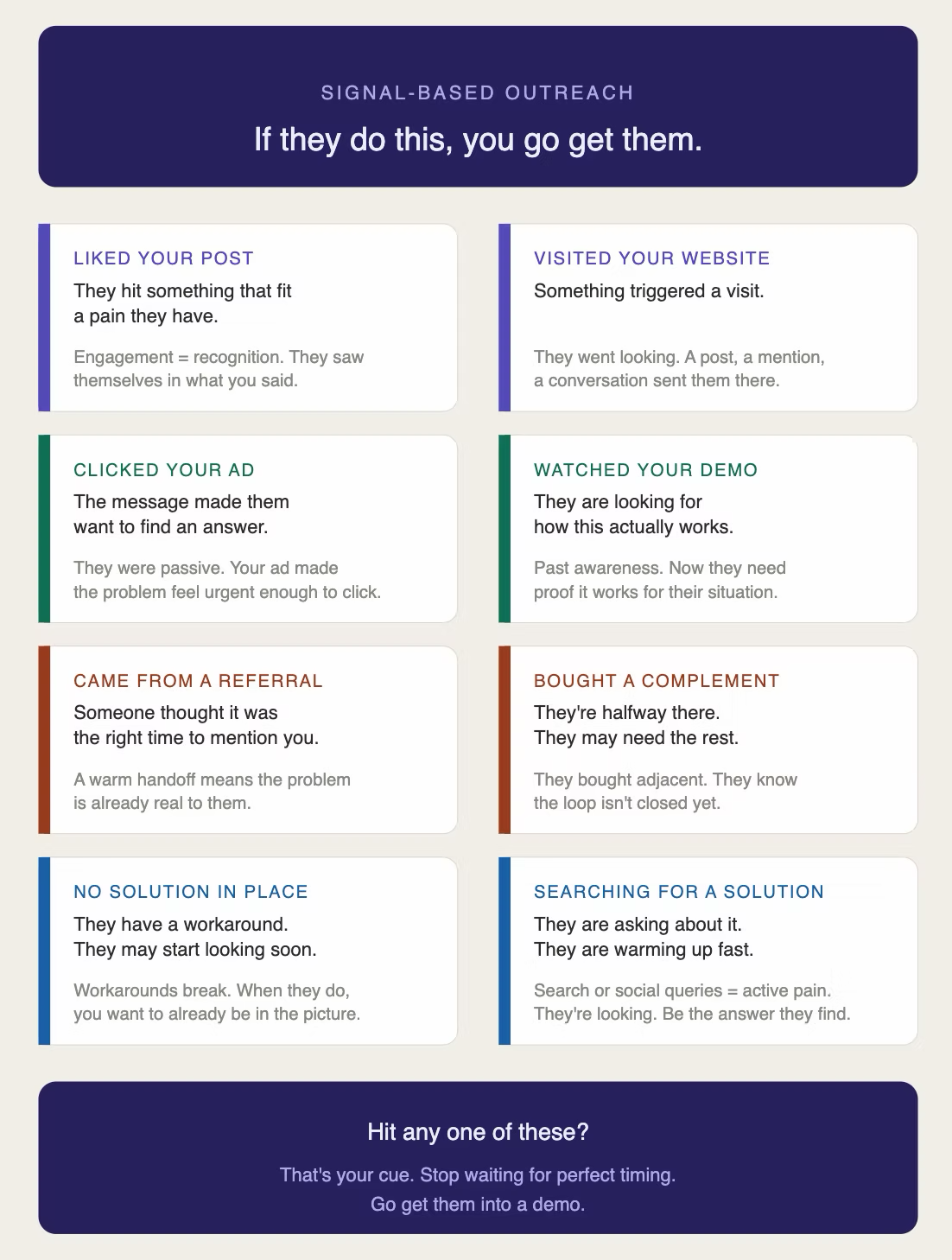
Map your outreach triggers to buyer behavior. Any single signal justifies a message.
Awareness signals: they know you exist and something clicked
They liked your post.
Sounds small. It's not. Liking something means they stopped. Something in what you said matched a problem they're sitting with right now. That's not a vanity metric. That's a hand raise.
They visited your website.
Nobody lands on a B2B website by accident. Something sent them there. A post, a conversation with a peer, your name coming up somewhere. They were curious enough to go look. That curiosity doesn't last forever.
Intent signals: they're actively looking for an answer
They clicked your ad.
Your ad interrupted them and they clicked anyway. That's a high bar. It means the message connected with something real and they wanted more. They weren't just browsing. They were looking for an answer and yours felt worth investigating.
They watched your demo.
This is one of the strongest signals on the list. Watching a demo takes time and intent. They're not just aware of you anymore. They want to understand specifically how it works, which usually means they're quietly evaluating whether it fits their situation. If you don't follow up within 24 to 48 hours of a demo view, someone else will.
Trust signals: someone or something already did the work for you
They came from a referral.
Someone in their network looked at their situation and thought of you. That's a judgment call, not a coincidence. The referrer believed the timing was right. You're walking in with credibility you didn't have to earn from scratch.
They bought something that sits next to your product.
This one is underused. If someone just invested in a tool that complements yours, they've already committed to solving a related problem. They're halfway there. They may already be thinking about what else they need to close the loop. It's a natural entry point and it doesn't feel cold.
Gap signals: the need exists, even if they haven't acted on it yet
They have no solution like yours in place.
A workaround is just a problem that hasn't broken yet. They know the current approach isn't right. They're just not ready, or not resourced, or the pain isn't sharp enough yet. That changes. Workarounds break down, teams grow, priorities shift. If you're already in their peripheral vision when that happens, you win.
They're searching for a solution on search or social.
Someone asking questions about the problem you solve is about as warm as it gets before an inbound lead. Whether it's a LinkedIn post asking for tool recommendations or a Google search landing on a comparison page, they're actively seeking an answer. You want to be the one who shows up.
You don't need all eight. You need one.
None of this requires every signal to fire at once. Any one of them is enough to justify reaching out. The point is to stop guessing and start reading.
Cold outreach fails because it's disconnected from where the buyer actually is. You're interrupting someone who has no context and no reason to care. Signal-based outreach gives you a reason. The message lands differently when it's "I noticed you checked out our demo" instead of "we help companies like yours drive results."
If you're doing your own outreach as a founder, even a basic system for tracking these signals in a spreadsheet will change your hit rate. You stop spending time on contacts who have no reason to talk to you and start spending it on people who are already halfway there.
FAQs
What is signal-based outreach?
It is the practice of reaching out to a prospect based on a specific behavioral cue rather than a static list or arbitrary timing. Instead of interrupting someone cold, you reach out when their actions suggest they are ready or open to the conversation.
What counts as a signal?
Anything that indicates a change in awareness, intent, trust, or need. That includes things like viewing your website, clicking an ad, watching a demo, coming through a referral, or buying a complementary product. Even a LinkedIn like qualifies.
Do I need a sophisticated tech stack to track signals?
No. A spreadsheet works. The goal is to stop treating all contacts the same way and start prioritizing people whose actions tell you something. Tools can help you scale, but the mindset shift matters more than the tooling at the start.
How quickly should I follow up on a signal?
It depends on the signal. A demo view is time-sensitive. You should follow up within 24 to 48 hours. Other signals like a website visit or a LinkedIn like give you a reasonable window, but the longer you wait, the more that initial curiosity fades.
What if I only have one signal? Is that enough to reach out?
Yes. The whole point is that one signal gives you a legitimate reason to start a conversation. You are not guessing. You have context. That changes how your message reads and how the prospect receives it.
How is this different from intent data tools?
Intent data tools are one way to surface some of these signals at scale, particularly search behavior and third-party content consumption. But you do not need a paid tool to practice signal-based outreach. Many of the most useful signals, like referrals, demo views, or ad clicks, are already sitting in systems you have access to.
Written by Osnat Lidor
Talk to us